ApniBloc
Airway Support System for Assisted Ventilation
A bite block and chin strap system designed to help maintain mandibular advancement while preserving procedural access during airway support.
2025 – 2026
Project Poster
Problem
Airway obstruction can complicate procedures requiring assisted ventilation or endoscopic access. Existing approaches may require providers to manually maintain jaw thrust or use devices that do not fully balance airway support with procedural access.
Our goal: design a device that supports mandibular advancement while still allowing access for clinical tools such as an endoscope or suction.
- Maintain airway patency
- Allow procedural access
- Reduce manual provider effort
- Adapt to patient anatomy
Research & Background
Airway Anatomy & OSA
This section is useful because it explains the actual reason the device needs to exist. Before thinking about a mouthguard, chin strap, or airway support system, we needed to understand what is physically causing the airway to close in patients with OSA. The research here helped connect the problem to tongue position, soft palate collapse, and reduced airway space. That made mandibular advancement feel like a more justified design direction instead of just a random mechanical feature.
Tan SN, Yang HC, Lim SC. Anatomy and Pathophysiology of Upper Airway Obstructive Sleep Apnoea.
Jordan AS, White DP. Pharyngeal motor control and the pathogenesis of obstructive sleep apnea.
Gottlieb DJ, Punjabi NM. Diagnosis and Management of Obstructive Sleep Apnea: A Review.
Sedation & Endoscopy Risk
This section matters because it shows why OSA becomes especially risky during procedures like endoscopy. Sedation changes the situation because patients are not fully intubated, but their airway muscles and protective reflexes are reduced. That helped us understand why a patient who may normally manage their airway can become unstable during a procedure. This research made the project feel more clinically specific, since the device was not just for sleep apnea generally, but for airway support during sedated procedures.
Workflow & Device Gaps
This section was developed through root cause analysis and mind mapping (see page 9 of the document). It helped show why current tools fail to address the full procedure: they may support the airway but still limit endoscopy positioning, scope access, bite block compatibility, patient comfort, or provider workflow.
Stakeholder Analysis & Sizing
This card highlights the three analyses that refined the project scope and priorities without needing external papers.
- Stakeholder analysis: identified key users, providers, and procedural roles that need support.
- Problem sizing: quantified the clinical and workflow impact so the design addressed real procedural risk rather than a generic sleep apnea problem.
- Competitive analysis: compared existing airway tools and highlighted the gaps that this device needed to fill.
Design Requirements
The ApniBloc system was designed around a few core requirements that came directly from the clinical need, traceability matrix, and planned verification testing. The device needed to maintain a jaw-thrust-like position, fit a range of patient anatomy, preserve procedural access, and remain safe during use. Because the system includes both a mouthguard/bite block and a chin strap, the requirements also account for how those two parts work together rather than treating the device as a single isolated mouthpiece.
View traceability matrix (PDF)
- ✓Maintain Mandibular Advancement – displace the mandible at least 5 mm forward from the maxilla to support airway patency during supine or lateral positioning.
- ✓Accommodate Patient Anatomy – adapt the mouthguard to different dental arch sizes and the chin strap to variation in head and neck dimensions.
- ✓Preserve Procedural Access – allow visualization of the oral cavity and maintain compatibility with tools such as an endoscope, suction catheter, oxygen mask, and emergency airway equipment.
- ✓Prevent Patient Injury – withstand bite forces without breaking and avoid excessive force on the teeth or overextension of the jaw.
- ✓Remain Simple and Clinically Practical – be easy to place and remove without adding more than 3 minutes to workflow, with critical components removable quickly during emergencies.
- ✓Support Infection Control – keep the mouthguard/bite block single-use and make the chin strap compatible with standard hospital laundering or sanitization protocols.
Prototyping Process
The design moved from mouthguard geometry first to system-level stabilization. Early mouthguard revisions focused on bite plate spacing, tool access, and mandibular offset, while the chin strap prototypes explored how to hold that advancement without blocking clinical workflow.
Mouthguard Progression

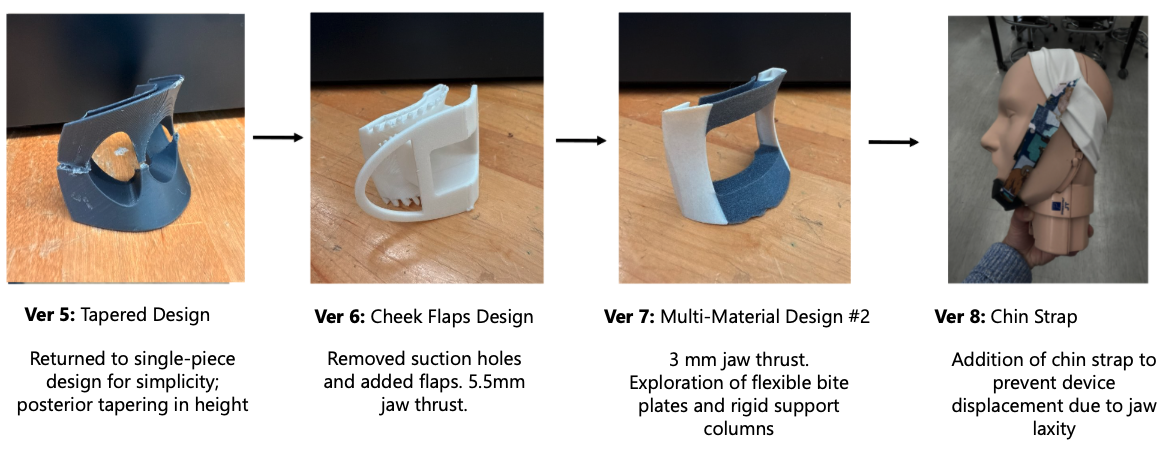
The mouthguard progression moves from early bite block coverage through premolar, two-piece, multi-material, tapered, and cheek-flap revisions before expanding into chin strap stabilization.
Chin Strap Prototype 1

The first chin strap iteration used thinner straps to explore how external stabilization could hold the jaw position.
Chin Strap Prototype 2

The second iteration used a more comfortable neoprene composition and quick release buckles for physician access.
Interactive Design Model
Bite Block 3D Model
Explore the bite block component in detail using this interactive 3D model. Use your mouse to rotate, zoom, and inspect the mouthguard geometry, bite plate positioning, and surface features that define how the device interfaces with the patient’s dentition.
Controls: Drag to rotate · Scroll to zoom · Double-click to reset
Download 3D Model (GLB) Download 3D Model (STL)Testing & Results
Mandibular Advancement Verification
The device was evaluated for its ability to create forward displacement between the upper and lower bite plates. This mattered because the goal was to support a jaw-thrust-like position that could help move the tongue away from the airway.
Target mandibular advancement criterion.
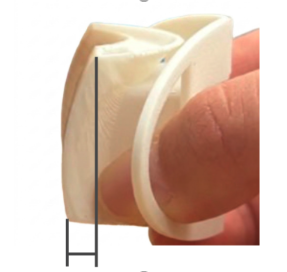
The mouthguard design preserved tool access while supporting stable bite positioning.
Chinstrap Testing
The chinstrap prototype was tested for adjustability and fit across external head and neck anatomy. We measured the front-to-back stretch distance, side-to-side stretch distance, and upper fabric length at the smallest and largest strap settings to compare the prototype against the adult sizing requirement.
- Front-to-back: 9.7-11.4 in measured, converting to 157-185 mm.
- Side-to-side: 9.4-11.5 in measured, converting to 152-186 mm.
- Upper fabric piece: 4.2-5.4 in measured, converting to 107-137 mm.
152-186 mm width
Final length and width adjustment ranges for DR.M2.3 sizing verification.
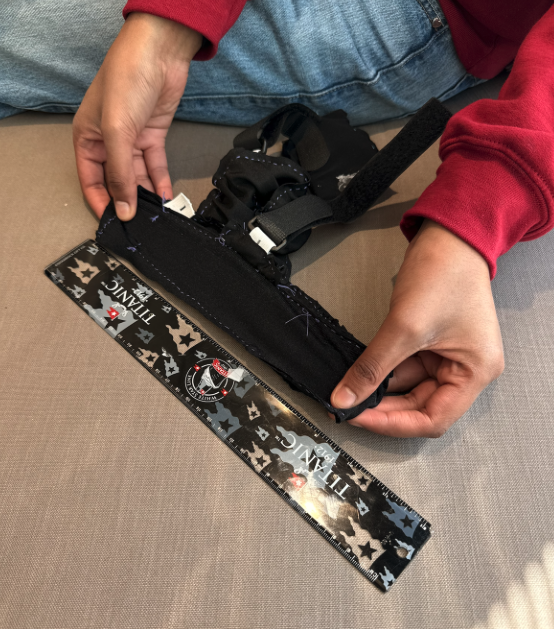
The measured ranges were compared with target criteria of 170-195 mm length and 140-160 mm width.
FEA / Structural Analysis
FEA was used to evaluate three loading cases in trial order. Each trial produced a minimum safety factor above 2.0, helping confirm that the bite block geometry had margin against structural failure under the simulated loading conditions.

Trial 1: Bottom Plate Loading
Loading was applied to the bottom plate to evaluate stress concentration through the lower bite surface.
SF 2.93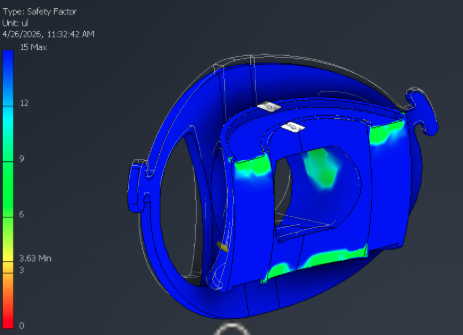
Trial 2: Bottom Plate + Forward Jaw Force
Combined loading captured the bottom bite force with an added forward jaw force from mandibular advancement.
SF 3.63
Trial 3: Top Plate Loading
Loading was applied to the top plate to evaluate the upper bite surface under opposing contact forces.
SF 2.28Minimum safety factor by trial: 2.93, 3.63, and 2.28 respectively.