
Loading Solution 2 gear 1 model…
Design Team
Influo
Directed flushing system for clogged percutaneous drains
Influo is a catheter add-on designed to reduce clogging in percutaneous drainage procedures. Our team translated clinician interviews, competitive research, concept selection, CAD, prototyping, verification testing, and design master record documentation into a directed flushing mechanism that targets catheter side holes during routine flushing.
View One-Page PosterMy RoleConcept selection, CAD support, prototyping, verification testing, and design documentation
Location / DatesJohns Hopkins Design Team
2023 – 2024
2023 – 2024
OutputsOne-page poster, final design paper, V&V summary, DMR package, and test data
Skills LearnedClinical interviewing, requirements tracing, CAD iteration, bench testing, risk analysis
1
Project & Problem Background
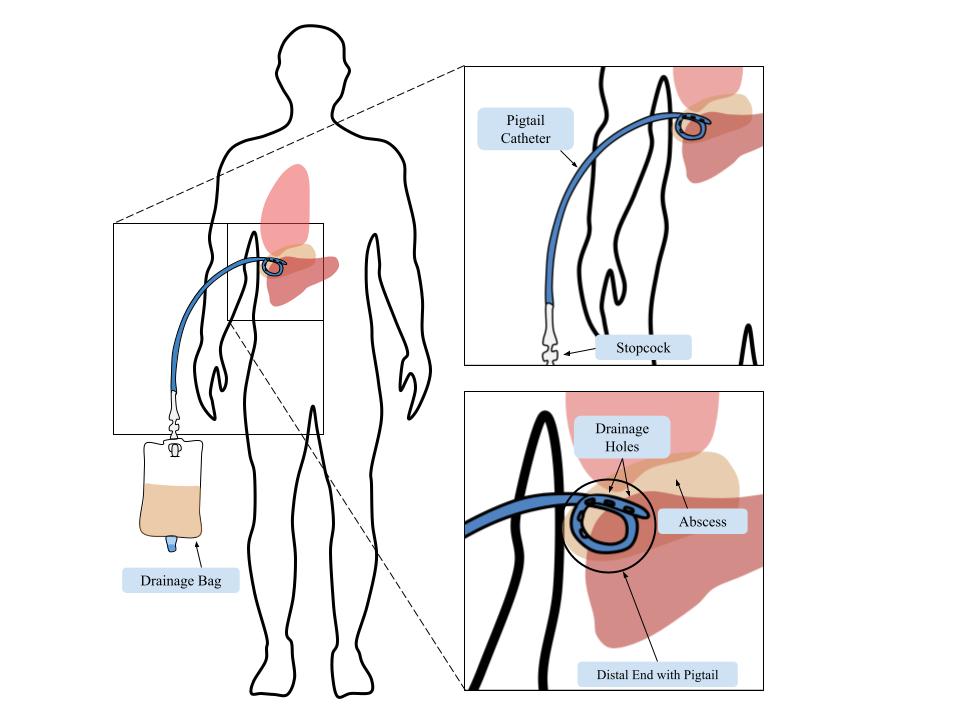
2
Detailed Requirements
- ✓Fit the existing procedureIntegrates with normal drain flushing behavior instead of asking clinicians to adopt a new procedure.
- ✓Direct flow toward blocked side holesTargets clogged side holes instead of allowing saline to escape through already-open holes.
- ✓Maintain a small catheter-compatible profilePreserves compatibility with the geometry and constraints of percutaneous drainage catheters.
- ✓Advance in controlled incrementsUses a repeatable twisting actuation motion to move the intraluminal tube along the catheter.
- ✓Protect the patient-facing interfaceImproves the flushing pathway without requiring full catheter replacement during the intervention.
- ✓Produce measurable evidenceSupports verification through side-hole coverage, flushing order, and directed-flow bench tests.
3
Prototyping
Solution 1 component breakdown
Exploded-view animation breaking the first solution into its major device components.
Solution 2 assembly and operation videos
Assembly movie for the updated device build.
Operation movie showing the new device actuation.
4
3D Model Explorer
After the prototype videos, the CAD explorer shows the component models used to develop the actuation assembly. GitHub links prioritize GLB files so the models open in GitHub’s interactive 3D viewer.
Loading Solution 2 gear 2 model…
Solution 2 Gear 2
Second gear element for the updated mechanism-of-action assembly.
Loading Stable Mechanism model…
Stable Mechanism
Stationary actuation component that supports controlled tube advancement.
Loading Nut model…
Loading Luer Lock model…
Loading Intraluminal Tube model…
Intraluminal Tube
Inner tube that redirects saline toward the next clogged side-hole region.
Loading Catheter model…
Catheter
Drainage catheter geometry used to test side-hole flow behavior.
Loading Active Mechanism model…
Active Mechanism
Moving actuation component that translates user input into tube advancement.
5
Bench Testing Results
Bench testing compared regular flushing against directed flushing across drainage flow rate, clogged-hole configurations, and pigtail stability.
Directed flushing bench-test clip showing fluid routing through the catheter model.
Repeated directed flushing clip used to compare consistency across trials.

Additional data collected
Flow-rate comparison
3.74 mL/sMean directed-flushing flow rate from the advanced drainage test data.
2.56 mL/sMean regular-flushing flow rate from the same drainage test set.
p = 0.00006Two-sample t-test result from the drainage testing spreadsheet, below the 0.05 significance threshold.
10/10Directed clog-configuration trials cleared all clogs in the listed test series.
6 configsClog-configuration testing compared regular and directed flushing across six blocked-hole patterns.
<1 degPigtail stability testing kept the pigtail curve within one degree of its original shape across trials.
6
Final Package

One-Page PosterOpen the final poster image.PNG Poster
Final Design PaperOpen the complete design paper with mechanism rationale, prototype behavior, and validation evidence.PDF Paper
Verification & Validation SummaryBench and validation evidence package for DHF4.DHF4 PDF
Design Master Record TOCIndex for final design record files, CAD files, drawings, and manufacturing documentation.DHF4 DOCX
Risk MatrixRisk analysis and controls documented for the final package.DHF4 XLSX
Project ManagementGantt chart and planning artifacts from the DHF4 submission.DHF4 XLSX
Design Requirements UpdateUpdated design requirements from the DHF4 package.DHF4 DOCX
Prototype Design JournalFinal prototype design journal from the DHF4 update set.DHF4 PPTX
FDA Pathway MemoRegulatory pathway memo from the DHF4 update set.DHF4 DOCX
Final SlidesDHF4 presentation slides for the final package.DHF4 PPTX